The Department of Digital Arts and Experimental Media (DXARTS) is pleased to present an evening of electronic music showcasing works by Richard Karpen, Joseph Anderson and Juan Pampin. The works will be played through the DXARTS 3D audio system, a state-of-the-art, high-fidelity multi-channel system designed for immersive, spatial audio experiences.
Program
Mass (1997), Richard Karpen
Pacific Slope (2002), Joseph Anderson
Camera Cantorum (2000) , Richard Karpen
A Line (2015/25) , Juan Pampin
Denouement (1991), Richard Karpen
Mass (1997) 3:05
Richard Karpen
There are several commonly understood English language meanings of the word mass that are derived from a few different Latin or Greek roots. Mass can refer to an amount or magnitude of matter; to the religious ritual; to works of music based upon texts of that ritual; to a large group of people or things. This very foreshortened Mass, on the program this evening, opens with a quotation from the beginning of Little Wing by Jimi Hendrix. It ends with a fleeting step into a pastoral landscape. Between these two bookends is “betweenness."
Mass was composed in January 1997 as part of a set of 3-minute pieces by various composers commissioned by empreintes DIGITALes’ for their Miniature Concrète CD release.
Pacific Slope (2002) 26:20
Joseph Anderson
“Assuming form, it reveals shapes half-seen and then half-hid. In dark half-hid, a likening; in light half-dark, shapes visible.…”
Lao Tzu
The region of the North American continent which drains into the Pacific Ocean is referred to as the Pacific Slope.
Metaphor, ‘the wave’—unending, unyielding, paradoxically powerful, at the same time intangible.
The ocean as birth place and endless desert, both life and death—united without sentiment. The bell—the ancients’ call to transcendence.
At once an attempt to stay ‘the wave’, halt death and life; metal, the interior of earth—touched by man.
Yet masses move unheeding.
Pacific Slope is the third of three works comprising a cycle titled Epiphanie Sequence. While the three works are very much concerned with musical textures and gestures, they are also quite taken with turning out and hearing the inside of musical sounds. Much of the musical material is often merely a re-voicing horizontally, in time, or vertically, in frequency, of these ‘insides.’
Pacific Slope was first performed in 2002 at the Transparent Tape Music Festival 2 in Berkeley, California. A number of people assisted in gathering sounds—Jeff Silberman engineered the recording of bells in his studio just north of San Francisco, Matt Ingalls stood in icy Pacific waters at the Marin Headlands with Jeff’s Nagra strapped to him, and Juan Pampin and Mirta Wyrmzberg broke fallen trees in the Oregon Coast Range. Special thanks go to Dave Malham for his guidance and instruction regarding Ambisonic theory and practice, and to Sean Costello for his advice on DSP technique.
The Epiphanie Sequence is published by Sargasso Records, London (SCD28056).
Mastering: Dominique Bassal (Montréal, Canada).
Camera cantorum (2000) 12:45
Richard Karpen
Camera cantorum (singer’s room) is a sort of sonic analog to an array of old mirrors that reflect fragments of music from several of my works prior to this one. Old mirrors can become cloudy, cracked, and warped, creating reflections that are oddly magnified, dimly lit, and sometimes fractured. In Camera Cantorum we can imagine it is dusk, and we are looking into these old mirrors at the reflections of things that are far in the distance behind us; we might find ourselves making up a narrative or a landscape to explain what we are seeing/hearing. The works drawn on for this excursion include, Sotto/Sopra for violin and computer, Pericolose, un giorno, bellezze, for soprano, choir, and computer, and Life Studies #4 and #5.
Camera Cantorum was composed in 2000 in Seattle, and Bourges, France. It was commissioned by the Institut International de Musique Electroacoustique de Bourges.
A Line (2015/25) 24:50
Juan Pampin
“And then it has happened again, and now it starts to happen everywhere. But -he astutely adds- only in the metro I can realize it because to travel in metro is like being inside a clock. The stations are the minutes, you know, it is that time of yours, of now; but I know that there is a different time, and I've been thinking, thinking…”
Julio Cortázar, The Pursuer
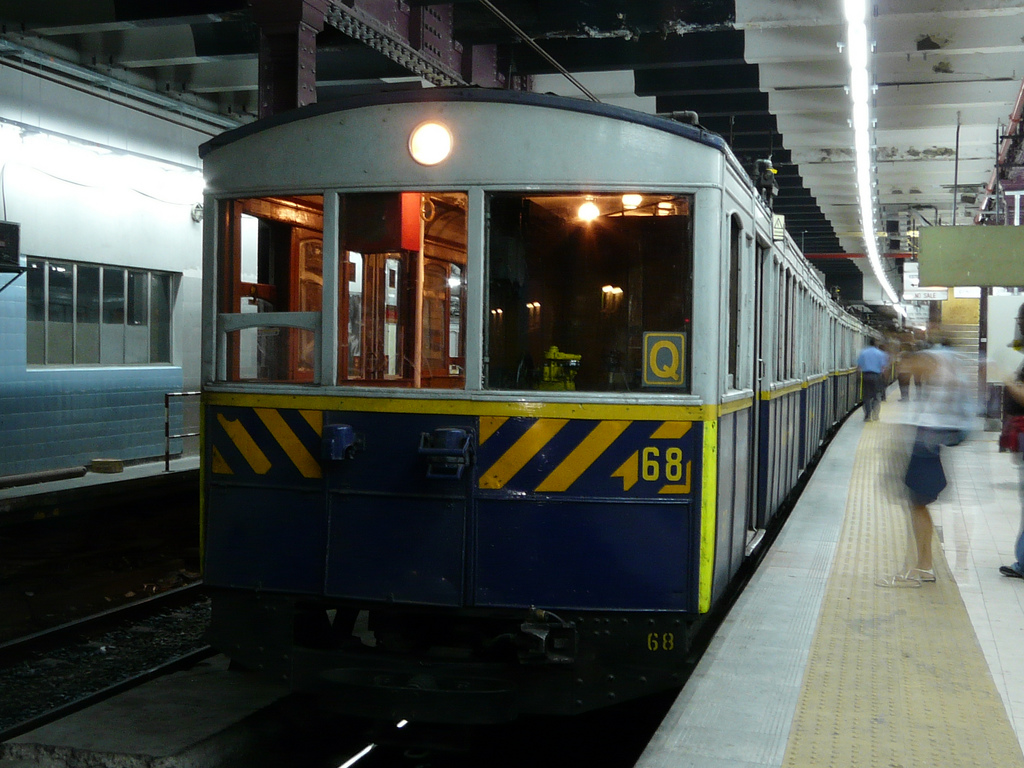
A Line was composed using field recordings from the city of Buenos Aires, captured over the southern springs of 2009, 2010, and 2011. The title of the piece refers to subway line A, the inaugural subway line of Buenos Aires, which started public service in 1913 and operated exclusively with its original wooden cars until 2013. Additionally, the title references the line that divides the South and North of the city along which line A traverses.
Line A served as the primary destination for my early urban explorations. My grandpa and I would spend countless hours riding in the front car, adjacent to the motorman, from which we could observe the signals and track changes. This journey would take us from the beginning to the end of the line in a loop. Occasionally, we would get off at one of the stations to visit one of the numerous parks along the line, which would momentarily divert my attention from the captivating underground experience. Plaza de Mayo, Congreso, Once, and Parque Rivadavia were among the places that brought me joy; where I would swing, feed pigeons, play soccer, and climb trees. However, nothing could compare to the exciting underground rides, which occasionally continued above the ground on the electric train that extends line A to the West, venturing into the suburbs.
It has been fascinating to share this experience with my son Eloy nearly four decades later. He quickly developed a fondness for line A, refusing to ride any other car except the front one. During my field recordings for the piece, he shared numerous rides with me, making many comments along the way. The composition depicts an imaginary journey through the city from his perspective: he embarks on the trip at the tender age of five and reaches the end of the line approaching the age of seven. Recordings from various locations and events occurring along the line (both above and below ground) were meticulously edited and transformed into a sonic landscape that attempts to capture the chaotic energy of this lively part of Buenos Aires.
A Line was composed using the Ambisonics Toolkit (ATK) in SuperCollider. The original binaural field recordings were transcoded to Ambisonic format for subsequent image processing. Subsequently, sounds were algorithmically segmented, analyzed, and catalogued employing audio classifiers and clustering techniques. Audio segments underwent digital processing, employing custom algorithms to generate textural transformations and transitions between soundscapes.
I would like to thank Joseph Anderson for his assistance during the mixing and mastering of A Line. Finally, I would like to acknowledge my son Eloy for sharing those wonderful subway trips with me.
Denouement (1991) 7:00
Richard Karpen
Denouement was intended to be the final section of my piece Terra Infirma. The very end (the end of this ending) is same in both pieces. I was working on a CD project with some other composers, and I felt that the arc of the procession of pieces could use a brief final statement. I retrieved the unused part that didn’t make it into Terra Infirma from temporary musical purgatory to create a coda for the CD. We’re using it in the concert this evening in a similar way. There’s also a connection with Camera Cantorum. Although the words are not discernible in Denouement, the LPC vocal re-synthesis used to create the chant-like beginning to Denouement was based on a reading of the text that I used quite a few years later in Pericolose, un giorno, bellezze which features prominently in Camera Cantorum.
Denouement was composed in 1992 in Seattle on a NeXT computer for the Centaur CD series, Composers of the Computer Age, which sounds a bit quaint 34 years later!